
 Enlarge diagram ↗
// TREATISE OBJECTIVES
- Understand cloud computing: foundational concepts, distributed computation, and on-demand resource virtualisation.
- Connect it to networking: map physical network elements (Switch, VLAN, Router, Server) to their cloud abstractions (Virtual Network, Subnet, Gateway, Virtual Machine).
- Apply it in projects: select the appropriate service model (IaaS, PaaS, or SaaS) according to governance, technical control, and architecture requirements.
Where Do Instagram, Google Drive, or Netflix Live? Are They on One Computer?
No. Modern applications and platforms rarely rely primarily on proprietary on-premises server rooms, captive hardware racks, or static local ISP circuits. Instead, systems are migrated and deployed on distributed cloud platforms.
Netflix's corporate headquarters are located in Los Gatos, California. However, serving millions of concurrent streams worldwide without latency degradation relies on a dual architecture:
- Centralised Compute and Storage: Netflix runs on Amazon Web Services (AWS) for large-scale business logic, user analytics, catalogues, billing, and media transcoding pipelines.
- Dedicated Edge Distribution: Video streaming does not traverse central AWS data centres for every viewer; it is served via Open Connect, Netflix's purpose-built Content Delivery Network (CDN). Open Connect places physical storage appliances inside Internet Service Provider (ISP) Points of Presence (PoPs) worldwide.
- Operational Reach: Operating across 200+ countries, geographically distributed caching ensures traffic traverses minimal physical distance, improving playback stability and preventing Layer-3 and Layer-4 bottlenecks.
Definition of Cloud Computing
Cloud computing is the on-demand delivery of computing resources over the Internet. It rests on virtual machines and logical abstractions enabling distributed computing across hundreds or thousands of interconnected servers.
This dramatically lowers upfront capital expenditure in physical server hardware, delegating physical maintenance and facility operations to subscription providers such as:
Core Characteristics of Cloud Services:
Resources and control planes are accessible anywhere via encrypted web consoles, CLIs, and programmatic APIs.
Elastic capacity to provision or deprovision memory, compute cores, and bandwidth in seconds as demand fluctuates.
Granular metering per compute second, gigabyte transferred, or request served, eliminating idle overprovisioning.
Redundant topologies spanning multiple Availability Zones (AZs) supporting Service Level Agreements (SLAs) up to 99.99%.
Networking Relationship: Hardware Virtualisation
A direct equivalence links classical networking concepts to cloud engineering: the cloud is the same underlying telecommunications network abstracted through Software-Defined Networking (SDN).
| Physical Network Element | Cloud Computing Equivalent (Virtualised) | Equivalent Operational Role |
|---|---|---|
| Switch | Virtual Network (VNet / VPC) | Interconnects virtual instances inside a software-controlled logical broadcast and routing domain. |
| VLAN | Subnet | Segments IP address ranges into public and private tiers to isolate databases and application servers. |
| Router | Gateway (Internet / NAT Gateway) | Enforces route tables directing packets across subnets and regulating egress/ingress with the public Internet. |
| Physical Server (Bare Metal) | VM (Virtual Machine / Instance) | Compute unit allocated virtual CPUs (vCPU), RAM, and block storage partitioned by a hypervisor. |
Cloud Service Models
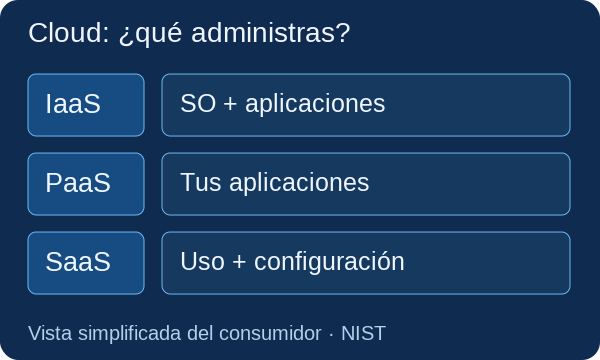
IaaS, PaaS, and SaaS are not mutually exclusive; organisations routinely combine all three models across their technology stack.
IaaS (Infrastructure as a Service)
Foundational Compute & StorageIaaS provides on-demand access to raw virtualised computing resources: hardware, virtual servers, storage, and networking. It gives organisations the foundational layer on which to install and manage their own software stacks.
• Customer responsibility: Operating system configuration, security patching, middleware, application code, and databases.
• Provider responsibility: Physical hardware, hypervisor virtualisation layer, cooling, power, and physical network fabric.
• Best suited for: Engineering teams requiring fine-grained system control or migrating legacy on-premises data centres.
• Canonical examples: Amazon Web Services (AWS EC2), Microsoft Azure Virtual Machines, Google Compute Engine (GCE).
PaaS (Platform as a Service)
Managed Build & RuntimePaaS offers a managed cloud runtime designed specifically to build, test, deploy, and scale applications without managing underlying OS patching or server capacity. Developers push application code and the platform handles serving and scaling.
• Customer responsibility: Application source code, business logic, and access configuration.
• Provider responsibility: Physical hardware, web servers, underlying operating system, runtime updates, and managed networking.
• Best suited for: Startups and agile software teams focused on rapid product iteration without infrastructure overhead.
• Canonical examples: Google App Engine, Heroku, AWS Elastic Beanstalk / AWS Lambda (Serverless), Firebase, Azure App Service.
SaaS (Software as a Service)
Ready-to-Use End ProductSaaS delivers complete, ready-to-use applications hosted and operated by the vendor over the Internet via web browsers or client apps. The provider operates the entire backend, storage, security patching, and feature releases.
• Customer responsibility: User account provisioning, role permissions, and day-to-day operational data usage.
• Provider responsibility: End-to-end management of infrastructure, platform, application code, databases, and security updates.
• Best suited for: Organisations of any size seeking immediate productivity software without systems administration.
• Canonical examples: Microsoft 365, Gmail / Google Workspace, Salesforce, Dropbox, Netflix.
Comparison Matrix: Characteristics & Responsibilities
| Dimension | IaaS | PaaS | SaaS |
|---|---|---|---|
| Customer control | Maximum (controls everything from OS upwards). | Medium (controls application logic and app data). | Minimal (controls tenant settings and user access). |
| Provider responsibility | Low (guarantees physical hardware, virtualisation, and network). | Medium (manages hardware, runtime, and underlying OS). | High (end-to-end service and full application operations). |
| What you receive | Virtualised compute, storage, and networking resources. | A preconfigured, automated development and hosting runtime. | A finished software product ready for end users. |
| Required expertise | Very high (systems architects, IT/cloud administrators). | High (software engineers, application developers). | Low (business end users and operators). |
| Customisation level | Total (custom architectures over bare virtual machines). | High (within supported frameworks and runtimes). | Limited (predefined configuration switches only). |
| Typical use case | Migrating local servers and custom databases to the cloud. | Building web/mobile apps without procuring servers. | Corporate email, collaboration suites, or CRM tools. |
Moving along the spectrum IaaS → PaaS → SaaS increases provider-managed operations and reduces the customer's technical and administrative workload.
Key Shared Traits Across Models
- Cloud paradigm: all operate on pooled, virtualised infrastructure provisioned on demand.
- Reduced physical footprint: none requires businesses to purchase, wire, or cool on-premises data centres.
- Scalability: capacity or user concurrency scales up or down almost immediately as business demand shifts.
- Usage or subscription billing: recurring operational expenditure (OpEx) aligned with actual resource consumption.
- Heavy ops offloaded to provider: physical security, redundant power, hardware replacement, and backbone connectivity stay with the vendor.
- Ubiquitous Internet access: accessed via standard browsers, REST APIs, or encrypted terminals from anywhere.
The Cloud Revolution: Technical & Business Impact
How these service models reshaped the way organisations build and consume software infrastructure:
Eliminates the burden of purchasing bare-metal servers, server racks, and dedicated cooling rooms.
Gives SMBs access to enterprise-grade compute, storage, and security tools previously exclusive to large corporations.
Compresses time-to-market: provisioning staging environments moved from months of procurement to minutes.
Absorbs sudden traffic spikes automatically via Auto Scaling and contracts capacity when load drops.
Transforms large depreciating upfront hardware outlays (CapEx) into predictable monthly operating costs (OpEx).
Enables remote engineering teams to collaborate in real time with synchronised environments.
Offloads cabling, failed drives, and firmware chores so engineers focus on differentiating software.
Allows global digital startups to validate and scale products with minimal initial capital.